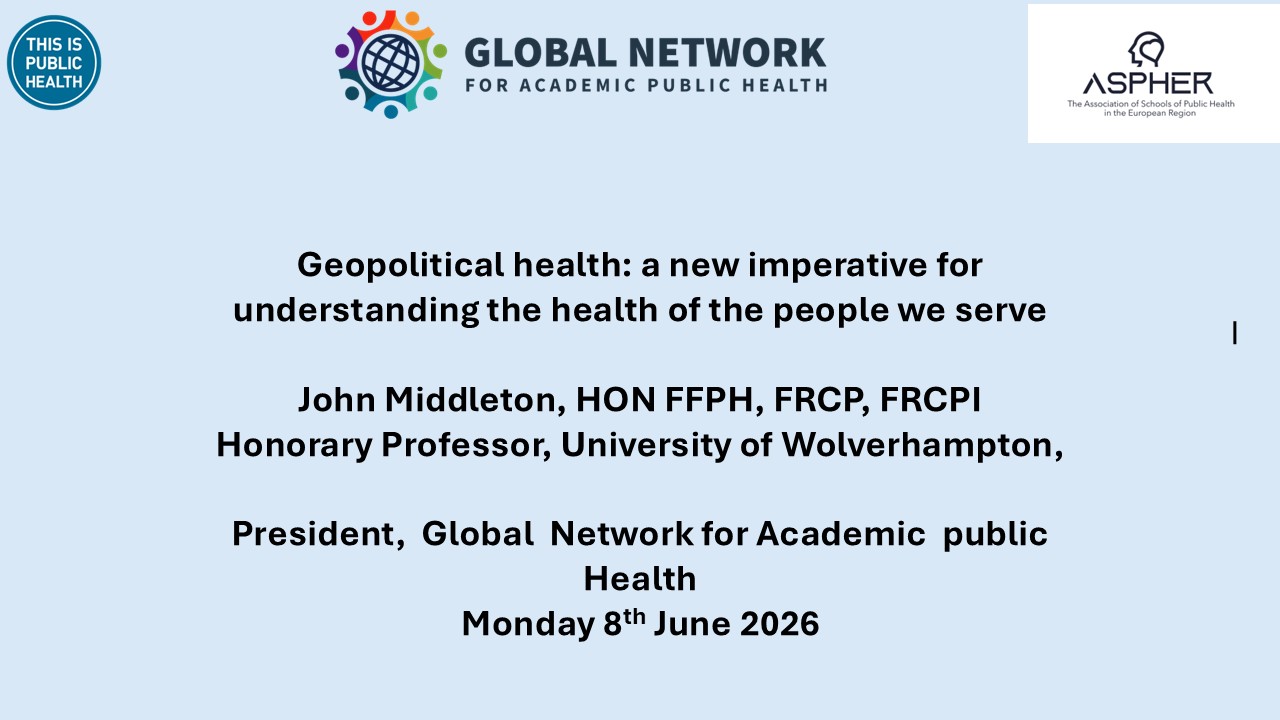
On 8th June 2026, CHAD and the Faculty of Public Health hosted this webinar on ‘Geopolitical health: a new imperative for understanding the health of the people we serve’, with John Middleton, Honorary Professor of Public Health at the University of Wolverhampton, and President of the Global Network for Academic Public Health.
In this webinar, John expertly set out why there has never been a more important, or challenging, time to be in the service of the health of the public. John reflected on a broad range of issues, including why it is that we have failed to reduce health inequalities, why there has been so little action on climate breakdown, and the power of the tobacco, drink, and food industries. John talked through how the ‘causes of the causes’ of public health problems, from poverty through to international conflict, can be found in the major geopolitical trends of the last 40 years. Geopolitics, John explained, affects all administrations, policing, and all public health services and outcomes.
John then set out seven priorities as crucial for the public health community to understand and address. These included, believing that health and quality of life can be better for all people, everywhere in the world, and for the planet; to think about inequalities in health and how to reduce such inequalities; to think global and act local; to keep developing our professional knowledge so that we can be useful and make a valuable, and needed, contribution; and ultimately, to understand the geopolitical world in which we live. You can read all seven of the priorities on John’s slides from the webinar.
You can download a copy of the speakers slides here.
A recording of the webinar is available below.
This marked the final webinar in the current 2025/2026 series on health inequalities. Many thanks to everyone that has joined us this series: all the speakers that have kindly shared their expert knowledge with us, everyone that has attended, engaged and asked questions, and to the team involved in delivering the series.
We look forward to returning in September 2026!
Please note, the views of any speaker do not necessarily represent the views or position of the Faculty of Public Health or the University of Staffordshire.