“So much more than just a free swim”: A participatory action research project to explore people’s experiences of OutSwimming Cancer.
In 2023/24 Dr Sarah Dean was lucky enough to get a space on the University of Staffordshire’s participatory action research (PAR) programme. Through this she was trained in how to carry out PAR and was supported to carry out a piece of research. In this blog post Sarah reports on working with community members to explore their experiences of attending the swimming cancer support group “OutSwimming Cancer”.
How the Project Came About
OutSwimming Cancer is a swimming group, set up by swimming teacher Lesley Rechert, where people who have had cancer can attend a supportive, free 1 hour weekly swim. Lesley could see that people really enjoyed attending the group and benefitted from it alot. She was keen to have some evidence of this to show potential future funders and other interested sports centres, so together we developed a project to evaluate the group.
Participatory action research (PAR) is a type of research that involves working very closely with communities to design and carry out research projects with the goal of making a meaningful change for that group. PAR projects should be fun and empowering for the people who take part, and usually involve lots of creative activities to involve community members in as many stages of the research as possible. I love this approach to research because it recognises that the group you are studying are experts on the topic and have lots that they can contribute to the project. We thought this approach seemed perfect for our work.
What were our aims?
We aimed to work with group members to evaluate OutSwimming Cancer and to find ways of sharing the value of the group with others.
How the project ran:
The project took place over 9 weeks. Members of the OutSwim group met in the leisure centre café after their swim to get involved. We also collected data at the poolside and even in the pool! This made taking part easy for group members and also meant in the café we could provide refreshments, which is another important aspect of PAR because sharing food and drink can help people to relax and get talking. Together we shared ideas and experiences about how attending OutSwim makes people feel, what they like about the group and what they would change about the group. We did this in different ways like writing ideas on post-its, having discussions and chats, and interviewing a few group members. We started to analyse the data together, put together an action plan of what we hoped would happen with the group moving forwards and thought about who we wanted to share our research with. In our last session we had a lovely celebration of the project and shared what we had achieved so far.
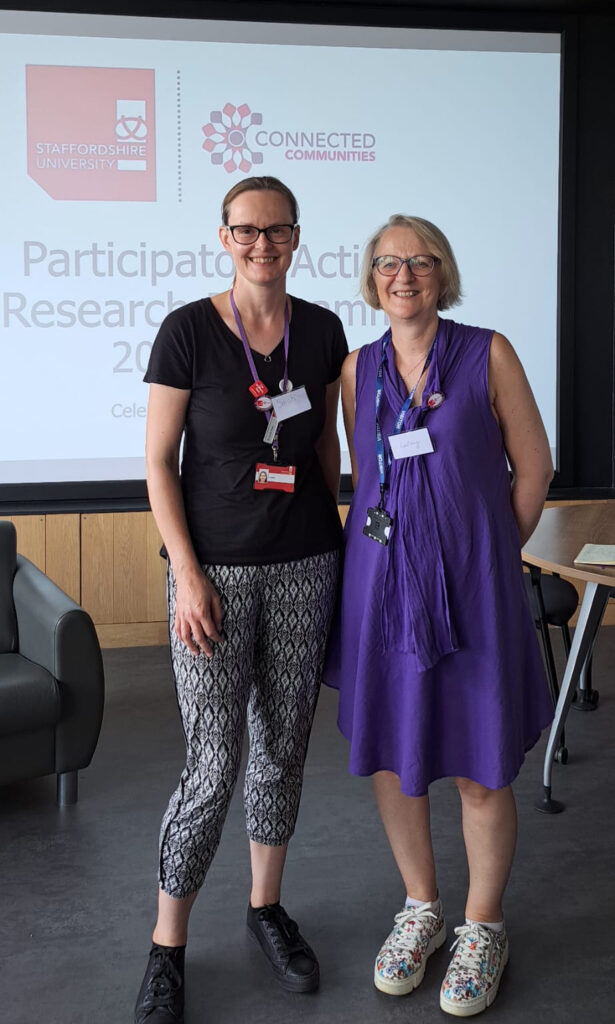
Sarah and Lesley
What did we find?
- Being able to attend OutSwim was really important and a very positive experience for people. Group members talked about benefits like feeling energised, confident and happy, being able to chat with other positive people who have had similar experiences, and seeing improvements in their health and how well they can swim.
Laura shared that “You can have a nice chat and in terms of a cancer support group it is one where you talk about being alive not about dying”. Another group member enjoyed “Meeting with a like minded community, swapping info that might be related to cancer (or not) todays chatter has been about knitting and crotchet!”
- People said OutSwim was a very welcoming and inclusive group. Lots of them enjoyed the freedom of “escaping” from cancer for a while by doing a nice normal activity.
Roxy explained that “I don’t want to be the cancer person, I want to be me and swimming helps me feel like that”.
Other group members shared “Water makes the rest of your body ‘invisible’ and is a great ‘equalizer’, we all look the same when we have wet hair, so the chemo effects are somewhat washed away – very liberating.” and “being free to walk around in a costume with breast prosthesis has felt liberating.”
- Lots of people said they had felt very anxious about attending their first OutSwim session, so it was really important that they had been supported to get them there.
Audrey told us that, “Lesley was an excellent calming influence on me and most certainly made me feel at ease. She managed somehow to assure me that swimming was most definitely something I could achieve.”
What have we achieved?
As a group we made a list of things we hoped would happen because of our research and are making great progress in achieving these!
- Encouraging more leisure centres to set up Outswim Groups
- To let others know there is life after cancer
- Access to swimming in school holidays (previously the group was only term time)
- Have aquarobics type exercises during the swim more often
- To continue meeting up in café when project ends
We found that people really valued and enjoyed taking part in the research! Meeting up in the café to work on the project helped group members to get to know each other and people felt proud of taking part and making positive changes. Group members shared that:
“This project has been just what we needed at the right time to make the group gel together. It has been wonderful and a chance to make some new friends”
“It’s been nothing but a positive experience at a time when everything else is NOT”
How did Lesley find taking part in the research?
Lesley says “from the very first OutSwimming Cancer sessions, I could tell that the swim was so much more than just the sum of its parts. I could see the visible impact of those first few lengths in the pool, when people’s worries would just fall off their shoulders. From being nervous and anxious in reception on their first visit, to having a wide grin on their faces after such a short time in the pool, you could tell that these sessions were something very special.
Over the time of the sessions, I saw people get fitter, become more confident, form lovely friendships, support each other and go onto to find the new post-cancer normal in their lives. For some Outswimming cancer was a stepping stone to becoming more active, losing weight and finding new possibilities in their lives. It has been very heartwarming to see the results of ‘just a free swim’.
It has been great to work with Sarah to capture my anecdotal evidence in a systematic respected way. The research will help us to promote the benefits of this type of session, and to spread the word to hopefully help other centres set up. The research process has been fun and inclusive and has had extra benefits, like bringing the group even closer together. It has been a really positive experience for everyone involved.”
What have I learnt from this experience?
I have really enjoyed learning a new way of doing research. As well as learning a lot about how important the OutSwimming Cancer group is to people, I have learnt that by working together you can achieve so much more than working on your own. I feel enthusiastic and excited about our research and am looking forwards to seeing what we can achieve next with our OutSwim project!
Current OutSwimming Cancer Sessions (as of June 2025):
Swimming sessions run independently and are currently in the Derbyshire area but we are hoping to encourage centres/pools in other locations to also set up OutSwims!
Mondays – Chesterfield Queen’s Park
Wednesday – Matlock Arc
Thursday evening – Staveley, Chesterfield, Healthy Living Centre
Friday – Hathersage Swimming Pool (called Cancer Swim)
Further Information
If you are interested in learning more about OutSwimming Cancer session in Chesterfield, our research or are looking to set up your own OutSwim sessions we have a new “How to Guide”!
You can access it by following this link and scrolling down!
https://www.chesterfield.gov.uk/sport-and-leisure/activities/outswimming-cancer/
Artwork designed for the project by Mila Krajewska.